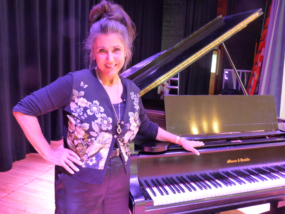
Photo Courtesy of Cicely Tyson School Oscar Petty is a master oboist and dedicated teacher, having spent more than 17 years inspiring young musicians. He has also travelled the world and played in some of its most famous venues.

Oscar Petty is a master oboist and dedicated teacher, having spent more than 17 years inspiring young musicians. He has also travelled the world and played in some of its most famous venues.
Mirvetk Tonuzi
Special to the Record-Transcript
He’s known around campus as Dr. Oscar Petty, the high school band and orchestra director at the Cicely L. Tyson Community School of Performing and Fine Arts.
Petty has spent more than 17 years developing young talent in the classroom, elevating the standard of musicianship while shaping the next generation of artists.
His students have gone on to win prestigious awards, including the Pulitzer Prize in Music Composition, and pursue careers in music and academia.
Beyond his quiet humility, however, he stands as an accomplished artist, principal oboist and conductor, balancing his passion for performance with his dedication to mentoring young musicians.
He has played with elite orchestras, including the Rome Festival Orchestra, Monmouth Symphony Orchestra, and the Orchestra of St. Peter by the Sea, in famous locations including Carnegie Hall, Alice Tully Hall, and even Vatican City, where he performed for Pope John Paul II.
Petty believes music is more than an art—it is a lifelong journey of learning, mentorship, and excellence. His belief in the power of mentorship and the importance of high standards stems from his own experiences, beginning with his parents’ quiet yet unwavering support. Encouraged by his high school band director, he took up the oboe at 14—due to its demand—and was performing widely by 15, opening doors to opportunities that shaped his career.
As his journey progressed, Petty found inspiration at music camps and conservatories, connecting with passionate peers and expanding his studies across the country.
At 17, he attended Kinhaven Music School in Vermont, where he met Matthew Brubeck, a talented cellist and son of legendary jazz musician Dave Brubeck. Dave Brubeck is widely known for recording the jazz mega-hit “Take Five,” composed by saxophonist Paul Desmond. This experience was followed by training in Michigan, California, and beyond.
At 22, he participated in the inaugural Los Angeles Philharmonic Institute under the guidance of Leonard Bernstein, Daniel Lewis, and other esteemed maestros.
One of the defining moments of his career was receiving praise from Leonard Bernstein, one of the most influential conductors of the 20th century.
“Even though he maintained professional diplomacy in his words, he described my playing as having a ‘gorgeous oboe sound’ in front of 100 musicians—that was huge,” Petty said. “My confidence level soared after the encounter with Bernstein and other musicians at the Hollywood Bowl performances.”
His most transformative experience came at 23 when he performed with world-class musicians at the Aspen Music Festival, an opportunity that forever shaped his musicianship and career. That opportunity led to performances with large orchestras, including a 200-musician ensemble at the Holiday Bowl, pushing his artistry to new heights. His career later took him across the globe, from Italy, Germany, and France to Switzerland.
One of the most surreal moments, he said, was when he played at the Vatican for Pope John Paul II, a performance that remains etched in his memory.
“Just to be in Vatican City, to see the artwork, the history—it was life-changing,” he said.
Petty believes that music isn’t hard—it’s challenging.
“If I can do it, you can do it,” he tells his students, using personal strategies, hands-on demonstrations, and technology to help them overcome obstacles. Whether adjusting tempo on a Smart Board, using pair-share activities, or approaching a piece from multiple angles, he tailors his instruction to the student.
Witnessing their breakthrough moments—mastering a passage or learning to read music—fuels his passion for teaching.
“It’s about breaking things down in different ways to solve the same challenge,” he said. “It happens regularly.”
Beyond the classroom, Petty continues to make his mark as a performer, playing with the Brook Symphony Orchestra under the direction of conductor Tom Vaca.
His advice to aspiring musicians and educators: “Embrace experience, discipline, and lifelong learning.”
He stresses the importance of mentorship, exposure, and perseverance, urging students to attend concerts, explore venues, and engage with professionals to refine their craft.
Petty also believes that professionalism and humility are essential.
“Conducting oneself in a decent and orderly manner does not hurt,” he said, emphasizing balance, adaptability, and persistence in the demanding world of music. He encourages artists to block out distractions, stay true to their vision, and remain open to learning—including new languages—to distinguish themselves.
Building on his decades of experience as both a musician and educator, Petty is channeling his insights into his upcoming book.
This work will explore the impact of mentorship, the challenges in urban education, and the transformative power of the arts, offering lessons for educators, students, and arts advocates.
About the Author