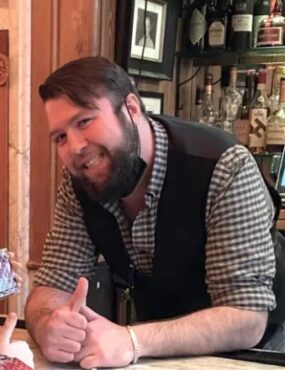
Retired mail carrier Carl Brown likes being outside in the elements so much that when he retired after 35 years with the Livingston post office, he got himself a job as a school crossing guard in Glen Ridge.
“I like working in a nice community with the kids, watching them grow, since I don’t have any children of my own,” he said the other day in a Herman Street coffee shop, a few steps from his post at Bloomfield and Ridgewood avenues. “I’m too bossy to be married. I like my own space. And being outside, I don’t get sick often. I take no medication at all. Last time I did was when I had double-knee surgery. I threw it out. I don’t believe in medication.”
Brown, 69, a Montclair resident, grew up in the Vauxhall section of Union, in a house his father built, and graduated from Union High School, class of ‘74.
After he graduated, he attended the Robert Walsh Business School and studied airline and travel business management. But he did not go this way because of an airline tragedy reported in the news that he took as a sign.
“That’s when my father told me to go to work for the post office,” he said. “I wanted to follow in his steps. He worked as a mailman in Newark for 35 years and retired at 65. So did I.”
His father also told him that once he was a mail carrier, stay a mail carrier and “keep your mind clear of the paperwork.”
Brown’s post is at the busiest Glen Ridge intersection, on the west side of Ridgewood Avenue. This is where the high school and train station are located, so most of the people he helps to cross are high school kids or morning commuters.
The crossing guard on the other side of Ridgewood Avenue contends with the safety of Ridgewood Avenue School students.
“The high school students joke with me because they’re growing up and getting taller than me,” he said. “I tell them, when you’re in high school, cherish it. After that, there’s so much pressure.”
At his fifth-year high school reunion, he recalled, some of his classmates had already died.
There is a photograph on his cell phone and he displayed it. It is an accident scene. A car had driven head-on into a pole a few feet from his post.
He did not see it happen because he was training a new guard right there and had his back turned. It was that close.
“It was on the second day of school,” he recounted. “The driver, a woman, had a medical incident. I went to her, but she didn’t know what happened. I told her not to move and EMS arrived. It happened at 3:55. The kids were gone.”
As a mail carrier, Brown spent a lot of time driving, watching the flow of traffic, and said he brings this mindfulness to his crossing work and tells the children
to remember to look where cars are traveling, too.
When he parks his car nearby, he remains vigilant and watches out for kids coming near it.
“I tell the kids to stay off the corner, it’s not a good place to stand,” he said. “You got to know your surroundings.”
Brown is also mindful of answering “nature’s call” and careful of drinking coffee before arriving at his post.
He simply cannot leave his post unattended.
“You have to know where the bathroom is, but you can’t take advantage of that,” he said. “I like fighting my own battles without someone helping me out.”
Brown is at his post from 7:30 to 9 a.m. and 2:30 to 4 a.m. A driver, he added, cannot make a right-hand turn on a red signal with a crossing guard present.
That is the law.
“Since I’ve been here, I’ve trained a lot of new crossing guards,” he said. “If I don’t think they’d make a good guard, I’ll tell my supervisor, Sgt. Matthew Koc. And I use the signal monitor as a guide when crossing people. The number starts at 18 and goes to one. At 10, I’ll stop the children. Who I cannot control are the adults.”
A signal monitor used by a crossing guard is a handheld device that allows them to remotely and safely control a traffic signal at an intersection.
It is a more advanced tool than the traditional “STOP” paddle, giving the guard direct control over traffic flow with the push of a button.
Several people interested in becoming guards asked him about the job.
“I asked them if they liked being outside,” he said. “You’re dealing with the elements and you’re dealing with traffic, the weather and children, from one corner to the other and they’re safe.”
Brown said he would not change anything about his life.
“You have to have a good attitude,” he said. “If you love what you’re doing, it’ll go by smoothly.”
About the Author