Photo Courtesy of Neuroscience Society at Seton Hall University Memory Cafe participants are engaging in a coloring activity to support relaxation, reduce stress, and enhance cognitive function.
By Abigail Moynihan
Correspondent
Carla was getting a little forgetful.
Her daughter thought The Memory Café could help.
The Café is a new partnership between Seton Hall University and the Maplewood Memorial Library that brings together students, library staff, caregivers, and individuals experiencing memory challenges in a safe, welcoming space designed to foster connection, cognitive engagement, and emotional well-being.
Participants connect over lunch, arts and crafts, live music, and other activities shown to support relaxation, reduce stress, and enhance cognitive function. It is free and open to all.
Carla, who is 62, moved to the area from Michigan in October to be closer to family. While never having attended anything like this before, Carla said that she enjoyed the way the program was being held because it allowed her a place to just sit and be present with what was in front of her.
“I like doing puzzles, this is nice to just be able to do,” she said. She noted how, at home, there are often 12 different things going on at once, but she never gets time to sit and enjoy the things she likes to do.
The Memory Cafe, which was held in February, March, and April, consisted of sections set up with cognitively stimulating activities including games like Connect Four, painting on canvases, coloring pages, sensory toys like stress balls, and puzzles.
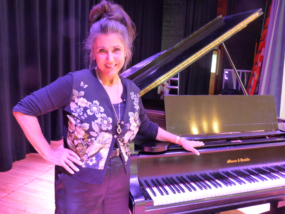
They also featured an array of blueberry-based snacks as blueberries have been proven to improve cognitive function. There was also live music played by members of the Seton Hall’s Neuroscience Society.
The Neuroscience Society was created a year ago by Alisha Dave, a sophomore biology and behavioral science student who is currently vice president of the Society.
Neuroscience is a relatively new major at Seton Hall and there was a lot of discourse both in and surrounding the major about how best to expand the importance of cognitive health to the greater community.
Dave said she created the Society her freshman year because she noticed that there was a lot of interest in the topic and “wanted to create a community that was really easy to come into.”
When asked about why the Memory Café is important, Dave said these types of issues know no boundaries.
“If you look around the room, genuinely, you have people from all backgrounds, races, genders, everything,” Dave said. “It is truly so diverse, and people are connecting over music, art, activity, with the shared goal of practicing cognitive skills to improve their health.”
The idea of the Memory Café blossomed from a walk that the Society did to support patients with Alzheimer’s and dementia. The Society wanted to find practical ways for patients to practice their cognitive skills in a safe, fun, and welcoming environment.
Since its inception at the beginning of the year, the Memory Café has had participants ranging from children to the elderly, as the Society believes that improving cognitive health knows no age.
When asked why the library was chosen as the meeting ground, Library representative Joanne Beckerich said that Dave reached out to her and asked if the library would be interested in participating in the event with them. Beckerich said that “we’ve provided the space, the publicity, and a few of the activities” to help the Memory Café succeed.
The Neuroscience Society plans on holding more installments of the Café during the next academic year and is looking forward to hopefully expanding the event into neighboring towns.

Memory Cafe participants are engaging in a coloring activity to support relaxation, reduce stress, and enhance cognitive function.
About the Author