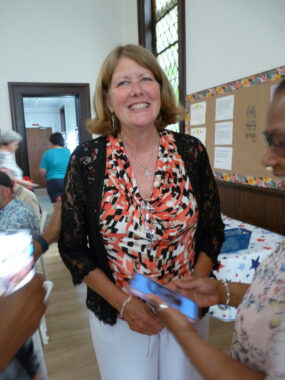
The Rev Diana Wilcox, of the Christ Episcopal Church of Bloomfield and Glen Ridge, is part of the planning committee for the celebration of the First Ecumenical Council.

This year marks the 1,700th anniversary of the First Ecumenical Council of 325, and the Nicene Creed, a “foundation marker” in Christian history.
The Episcopal Dioceses of Newark and New Jersey, working with the Roman Catholic Archdiocese of Newark, the Lutheran, Presbyterian and Reformed churches, as well as the Ukrainian Orthodox and others from the Eastern Church, celebrated this historic moment, on May 3, in a service at the Co-Cathedral of St. Robert Bellarmine in Freehold.
A force behind the effort for this celebration was Cardinal Joseph Tobin, archbishop of Newark. Tobin was not in Freehold but Rome for the convocation to elect a new pope. In his place, the Most Rev. David M. O’Connell, Bishop of the Roman Catholic Diocese of Trenton, presided. The Rev. Diana L. Wilcox, Rector of Christ Episcopal Church in Bloomfield and Glen Ridge, was part of the planning team and represented the Episcopal Diocese of Newark.
While the form of the Nicene Creed used in most Western churches today was amended at the Council of Constantinople in 381, and again by the Council of Chalcedon in 451, it was in 325 in Nicaea, located in present day Turkey, at the First Ecumenical Council, where it initially took form and was adopted.
Taught to Christian children and recited in church, the Nicene Creed begins with the words, “We believe in one God/The Father Almighty/Maker of heaven and earth/And of all things visible and invisible.”
The creed in use in the Eastern Orthodox churches differs from that of the West, as it never included the filioque, a word meaning, “and of the son.” The filioque was added after Nicea, but was rejected by the Eastern Church and was omitted in the creed used at the May 3 service as a sign of unity.
The Episcopal Church will be removing the filioque in the next edition of their Book of Common Prayer, and many parishes have been using that version, including Christ Episcopal Church. Wilcox remarked that “it took some getting used to for my congregation” to not use the filioque, “but they are used to it now. The Western Church is moving away from it.”
Instead, that part of the Creed says, “We believe in the Holy Spirit, the giver of life, who proceeds from the Father.”
The Ecuemenical Council of 325 was called by Emperor Constantine to resolve the conflict over the divinity of Christ. The Archbishop Alexander of Alexandria, along with others, held that Jesus was fully divine, of the same substance as God. Arius, a minister of the Church, however, led a faction that said Jesus was divine, but not of the same substance as God. Because of these distinctions, the church was in deep conflict.
In attendance at this Council of 325, was a certain Nicholas, Bishop of Myra, who later became St. Nicholas, the basis for the legend of Santa Claus. (In fact, “A Visit From St. Nicholas” was penned by Clement Clarke Moore, a professor at The General Seminary in New York City, an Episcopal Seminary and Moore’s father was an Episcopal Bishop.) As for Bishop Nicholas, at the Council of 325, there is a story that he became so enraged with Arius that he walked across the room and slapped him.
Wilcox said that there are so many present-day divisions around the country and the world, and the church has been historically divided, in particular between the Eastern and Western churches, about a number of doctrinal beliefs.
“To unite together, across the different churches within the East and the West,” she said, “and to say ‘We believe in one God…’ focuses our attention on what unites us, and truly that is far greater than what divides us.”
In his homily during the service, his Eminence, Metropolitan Anthony, of the Ukrainian Orthodox Church of the USA, said, “Let us be clear, my dearly beloved, to profess the creed is to confess Jesus Christ with our lips, but it is also to incarnate him within our lives. A Christian who says ‘I believe in one God’ must live as though they do, by serving the poor, forgiving the enemy, welcoming the stranger and radiating the light of Christ. In a world darkened by hatred and confusion, the creed then becomes not merely a theological formula, but a spiritual constitution, a daily manifesto of Christian life.”
About the Author