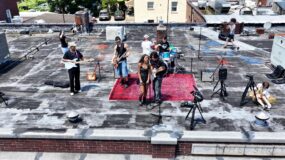
Thomas Edison National Historic Park workers have fun pantomiming some actions that would appear in the first films.
WEST ORANGE — Film lovers recently had the opportunity to star in their own film – 1800s style!
Thomas Edison National Historical Park recently hosted a hands-on workshop and demonstration on historic film making techniques in the Black
Maria. The Black Maria is a replica, constructed in 1954, of the world’s first motion picture studio. Edison’s motion picture experimenters, William K.L. Dickson and William Heise, produced between 200 and 300 films in the studio, which included the first sneeze in film history, the first kiss in film history, the first dance in film history and Annie Oakley footage.
Steve Cossman, founder and executive director of Mono No Aware, a 501c3 cinema-arts non-profit organization located in Brooklyn, led the workshop. Cossman explained that they teach filmmaking on film only. “It’s fun,” he said. “A lot of early films are known as kinetoscopes – very short films. Before TV, before cinema, it’s a wonder to see these things. The most famous, a man sneezing, a woman dancing. Very simple actions. A simple movement doesn’t need to be too complicated.”
Visitors took turns creating short five- to 10-second movies.
KeXin Wang was a visitor who truly captured the 1800s with his creative vision. He walked on to the set carrying a violin case. He opened it and expressed surprise that the case was empty. He then picked up an imaginary violin and began to “play” it.
Alex Parody, chief of interpretation and education at Thomas Edison National Historical Park, said, “Having the public come out and participate is a unique way to engage in one of the coolest facets the park has to offer. It’s a very experimental, palpable connection to the history of the site.”
Christopher Chan, park ranger, said that filming took place in the original Black Maria until the 1900s. “The Black Maria became important for Edison’s early film work,” he said.
Ranger Sue Kaufman recreated the recording of the first sneeze which was originally captured on film in 1894.
Parody and his children did a bunny hop.
Ania Kochanska paid tribute to Edison himself by holding a lightbulb and a photo of his face. She said, “I knew a bit (about Edison) but I didn’t know he was involved in so many innovations and contributions we use every day.” All the films were shown at the end of the day using historic camera equipment.
To learn more about Thomas Edison National Historical Park, visit: https://www.nps.
gov/edis/index.htm.
To learn more about Mono No Aware, visit: https://
mononoawarefilm.com/.
About the Author